
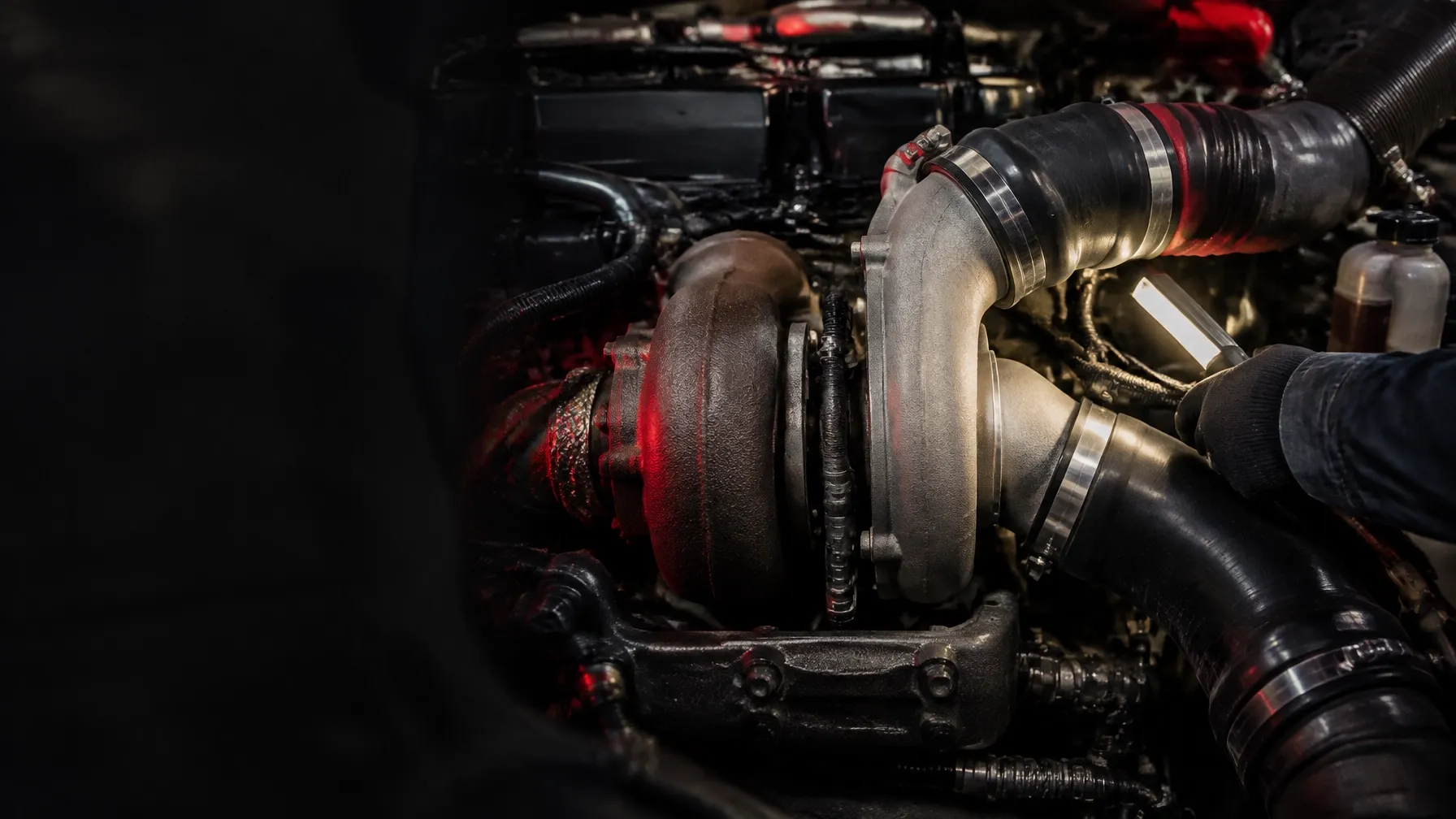
J1939 Diagnostics vs Generic Fault Codes: What Fleet Diagnostic Tools Miss

A fault code tells you that a threshold was crossed.
A J1939 signal review asks what changed before the threshold was crossed.
That difference matters in heavy-duty fleet maintenance. A code reader or telematics dashboard may show an active fault after the engine control module has already decided that a monitored value is out of range. The maintenance desk receives the event after the condition becomes visible.
A signal review works from the available data over a defined period. It compares operating behavior against a rolling baseline. The output is a candidate finding for human review, not an automatic repair order and not a guarantee that a failure will be prevented.
The practical sequence is:
Review the signal → rank the evidence → validate the physical cause → decide the next action.
A fault code is an event. A signal review is a comparison.
J1939 is the communication language used by electronic control units across many heavy-duty trucks, buses, and other equipment. It carries both diagnostic messages and operating signals.
The diagnostic side includes:
- SPN, Suspect Parameter Number: what parameter or subsystem is involved.
- FMI, Failure Mode Identifier: how the parameter is behaving abnormally.
- OC, Occurrence Count: how many times the fault has become active.
- PGN, Parameter Group Number: the message group carrying one or more signals.
- Source address: which ECU reported the message.
J1939 also carries live operating data such as:
- Engine speed and load
- Boost pressure
- VGT duty cycle
- DPF differential pressure
- Coolant temperature and level
- EGR temperature difference
- NOx values
- Oil pressure and temperature
- Fuel delivery signals
- Per-cylinder balance data, when available in the approved stream
A generic fault-code workflow usually begins when one value crosses a programmed limit.
A signal-review workflow begins earlier. It asks whether the value is moving away from the vehicle’s own normal pattern under comparable load, duty cycle, ambient conditions, or route conditions.
That is the difference between threshold detection and drift review.
DM1 and DM2 answer different maintenance questions
J1939-73 defines diagnostic messages used by heavy-duty equipment. Two matter most at the maintenance desk.
| Message | Status | Operator question |
|---|---|---|
| DM1 | Active diagnostic trouble codes | What is active now? |
| DM2 | Previously active diagnostic trouble codes | What happened previously, even if the lamp is off? |
DM1 normally carries active SPN/FMI codes and lamp status. It is used for current fault visibility and triage.
DM2 stores previously active faults since the ECU’s fault memory was last cleared. It can show intermittent issues that are no longer active when the truck reaches the yard.
That history has a limit.
If someone clears the fault memory, the maintenance record may lose part of the vehicle’s diagnostic context. A cleared code does not prove that the underlying condition was corrected. It only shows that the stored status was reset.
For that reason, preserve the following when possible:
- SPN and FMI
- Occurrence count
- ECU source address
- Timestamp
- Lamp status
- Surrounding operating signals
- Repair or clearing event
- Technician validation result
DM1 tells you what is active. DM2 can tell you what was active. Neither message, by itself, proves the root cause.
For background on J1939-73, DM1, DM2, SPN, and FMI, see the J1939-73 diagnostic message reference.

Drift can be useful before a code arrives
Consider a VGT actuator.
An illustrative review might show the actuator duty cycle moving 6.6% over 14 days. Every individual snapshot still falls inside the ECU’s normal operating range. No active DM1 code appears. A conventional dashboard may show “normal” on each individual read.
The rolling comparison shows a different operating pattern.
The drift does not prove actuator wear. It does not prove that the truck will fail. It creates a candidate signal for review.
The maintenance desk can then compare it with:
- Boost undershoot at low engine speed
- EGT behavior
- DPF differential pressure
- Recent regeneration intervals
- Short-trip or low-load duty cycle
- Ambient temperature
- Harness or connector history
- Recent calibration or reflash activity
The signal becomes more useful when the evidence is combined.
This is why the 6.6% figure is illustrative, not a Trodeon customer result. Whether a signal is available, stable, and useful for a specific fleet would depend on the supplied data, permissions, and written scope.
One code can have several competing causes
A fault code is not always a parts order.
A code related to boost, temperature, pressure, or actuator position may be consistent with several causes:
- A failed or drifting thermistor
- A sticky VGT actuator
- Soot-loaded vanes
- A damaged harness or connector
- A boost hose leak
- ECU calibration drift
- A sensor reporting error
- An operating condition outside the expected duty cycle
A single DTC answer can narrow the search. It rarely closes the investigation.
A ranked evidence set gives the maintenance team a better starting point:
- Primary hypothesis: the explanation with the strongest available evidence.
- Competing explanation: a plausible cause that still needs to remain visible.
- Rule-out path: the cheapest check that can remove an explanation.
- Evidence gap: the data or physical check still missing.
- Next action: the defined validation step.
That is the difference between “replace the turbo” and “review the VGT signal, check the harness, run the actuator test, then decide.”
Trodeon is being developed to support this kind of documented evidence review: source and timing, missing or conflicting records, and unresolved questions stay visible for the human reviewer. The review is decision support. It does not make automated diagnoses or take operational actions. See how Trodeon describes its own workflow.
Start with the cheapest validation step
Do not begin with teardown when a lower-cost read can answer the question.
A practical validation ladder is:
1. Cab-side CAN read
Start with the least-invasive check available within the scope.
Confirm whether the J1939 signal seen in the review matches the current vehicle data. Compare the duty-cycle counter, actuator position, pressure value, or temperature behavior against the relevant operating context.
Status: Non-invasive
Purpose: Confirm the signal and remove data-path or calibration questions.
2. Bench quick-test
If the cab-side read does not rule the component in or out, move to a controlled test.
A VGT actuator, sensor, or related component may be checked against a known response curve. This can help separate a component issue from a harness, connector, or driver problem.
Status: Minimal component test
Purpose: Narrow the physical cause without full teardown.
3. Teardown
Teardown belongs at the end of the ladder when cheaper checks cannot resolve the question.
Use it when the evidence and physical tests support the component hypothesis. Record what was found. Compare the result with the original signal review.
Status: Higher labor and downtime
Purpose: Confirm the cause and scope the repair.
The ladder is not a guarantee of diagnosis. It is a way to control diagnostic cost and avoid unnecessary parts replacement.

What this means for the maintenance desk
A generic code workflow often looks like this:
| Category | Generic fault-code workflow |
|---|---|
| Timing | After a threshold trips |
| Evidence | Code, FMI, lamp status |
| Cause | Several possibilities remain |
| Lead time | Often limited |
| Next step | Technician investigates after arrival |
| History | Reduced if codes are cleared |
A signal-review workflow looks different:
| Category | Candidate signal review |
|---|---|
| Timing | Before the threshold, when data supports review |
| Evidence | Trend, context, competing causes |
| Cause | Ranked hypotheses, not a single answer |
| Lead time | Depends on signal availability and review window |
| Next step | Defined physical validation |
| History | Review record tied to the data window |
Neither workflow replaces the technician.
A code reader still has value. DM1 remains important for active fault triage. DM2 remains useful for historical review. The limitation is that a single threshold event usually arrives after the condition has become visible to the ECU.
A signal review adds the time dimension.
Why mid-market fleets often get this later
Large OEM connected-fleet programs and advanced maintenance analytics have often been scoped for fleets with 1,000 or more units. That is a market-scope observation, not a universal rule. Coverage, pricing, data access, and OEM eligibility vary by program.
A regional carrier, leasing operator, or municipal fleet with 50 or more trucks may still have useful J1939 data. The problem is often access, review capacity, and workflow ownership.
The fleet may already have Samsara, Motive, or Geotab. The data may be available, but no one is comparing the right signals over a defined window.
If your fleet already runs Samsara, Motive, Geotab, or another telematics provider, that data may be useful input to this kind of review. No provider connection is represented here as active or established. Availability depends on the provider, device, permissions, and written scope.
Review the data-boundary description before assuming coverage.
What this kind of review records, and what it does not promise
An evidence review of supplied telematics data records:
- What data was available
- Which signals were reviewed
- What operating window was used
- Which evidence supported the finding
- What uncertainty remained
- What physical validation step was recommended
- Which questions stayed unresolved
No review of this kind detects every fault. It does not promise that a truck will not fail. It does not guarantee parts, technician availability, dispatch timing, repair completion, or savings.
“Before the fault” describes when the review happens. It does not mean that no fault will occur.
For Class 8 and heavy equipment, J1939 is the relevant data language. OBD-II support for lighter trucks in mixed fleets is a roadmap topic for the industry, not a current reading or installation capability described here.
Start with the data you already have
If your fleet has available J1939 data from your existing telematics provider, start with three items:
- The units you want reviewed.
- The data permissions already approved.
- The maintenance question you need to answer.
Trodeon is in development. The current public proposal is a conditional fleet evaluation for Class 8 operators: participation would depend on technical readiness, a written scope, and fleet authorization. Evaluation billing and any later purchase terms would be stated in an approved written scope before participation.
Review the proposed fleet evaluation, or call 937-234-7208 to discuss your maintenance workflow.
Reference notes
The technical descriptions of J1939 PGNs, SPNs, DM1, DM2, and FMI are based on the SAE J1939-73 diagnostic overview and the J1939 protocol introduction. External technical references describe the protocol and message structure. They do not represent Trodeon customer results or outcome guarantees.